SUMMER 2026 PROGRAMS

Programs & Curriculum

Three age-matched tracks. One goal: kids who can think computationally, build & design robots, and get them moving with code.

Camp Dates: July 13–17 & July 20–24 · 9am–3pm · University Chapel, UBC

Build & Program Robots with LEGO® Education kits!”

At Robotics Camps, kids create, build, program and operate robotic animals, machines and vehicles using LEGO® Education Robotics and Computer Programming. We place your child into grade level appropriate activities based on skill, ability, experience and preference.

🤖 Beginner Bots

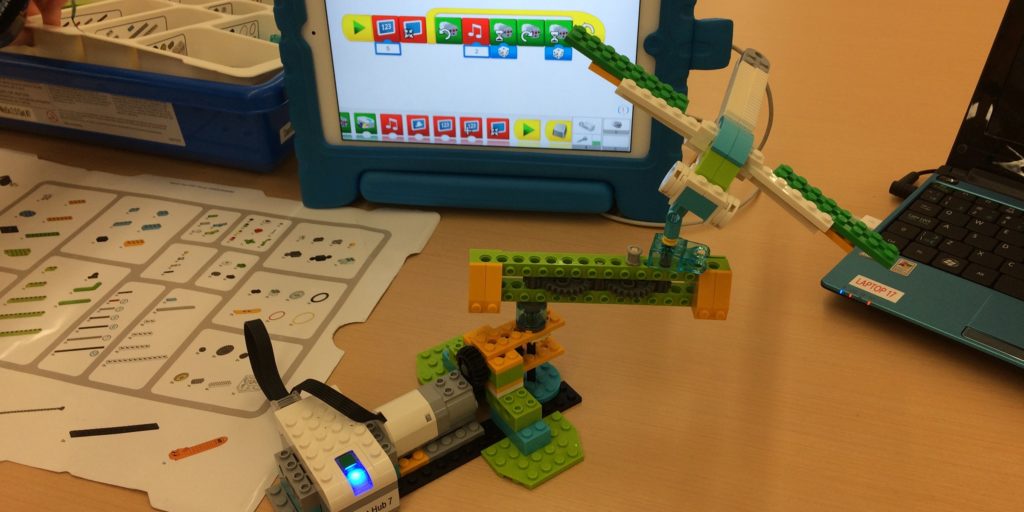
Kids use LEGO WeDo 1 or LEGO WeDO 2.0 kits with Bluetooth connectivity to build and operate a variety of mechanical constructions with programmable small motors and sensors. They are introduced to simple programming skills such as sequencing, looping Labview and Scratch.

Age Range:

  • Grades 1-2

What your child will learn

  • Basic computation thinking via block based code
  • Experimenting with gears, motors and sensors
  • Motor movement and sensor-triggered behaviour
  • Teamwork skills including turn-taking, working together to achieve a goal
  • Problem solving skills through hands-on daily robot missions and challenges

“I love building with LEGO and I can make my motors and sensors work!”
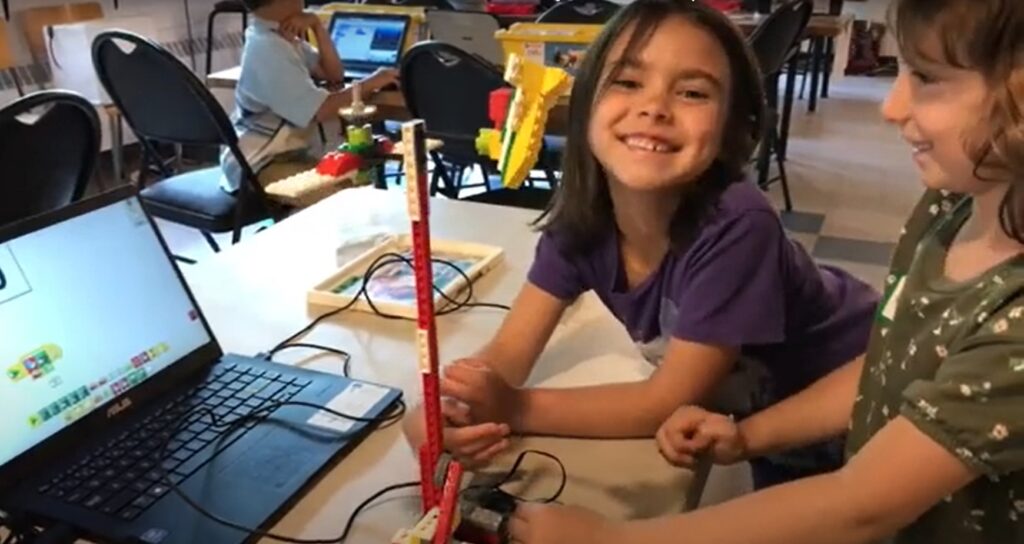
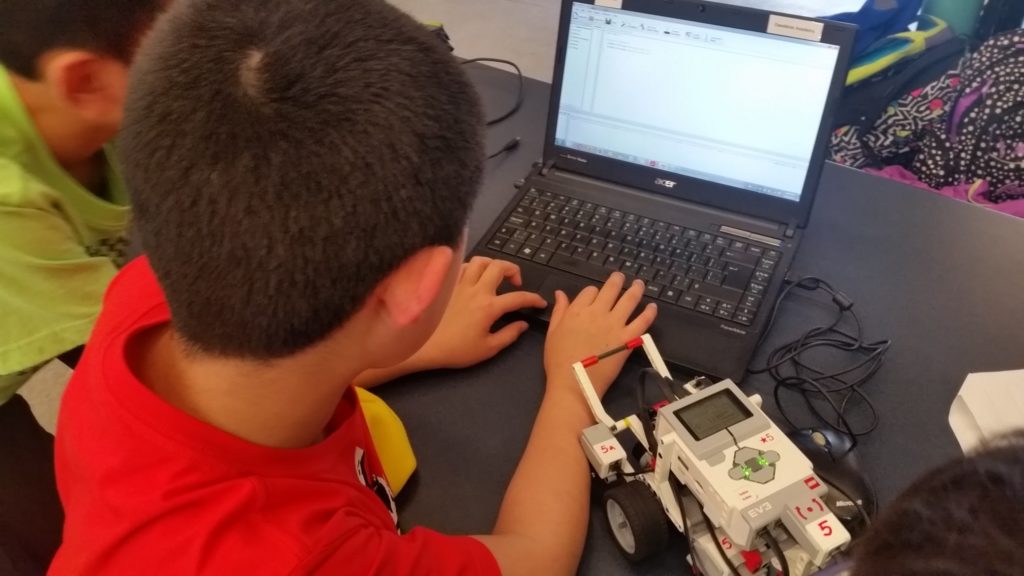
Young camper building a LEGO robot
LEGO WeDo 2.0 robotics build

🛠️ Young Engineers

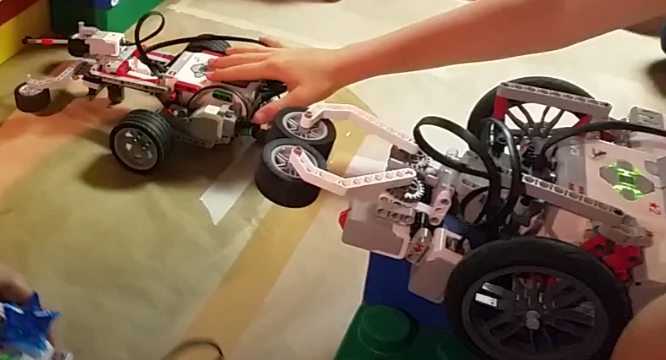
Typically for Grades 3-7 students, but based on assessed level of competency with LEGO building, coding and teamwork skills. Kids use LEGO Education materials (SPIKE Prime for grades 3-5 and LEGO® Mindstorms Ev3 for grades 6-7) to build and operate a variety of complex robotic constructions. In addition to building and programming motorized robots, they also interact with sensors. They strengthen their programming skills such as sequencing, looping, if-then statements, and variables, with increasingly complex tasks through testing and iteration.

Age Range:

  • Grades 3-7

What your child will learn

  • Building with motors, gears, and sensors
  • Sequencing and logic — the foundation of all coding
  • Loops, motor direction, and sensor-triggered behaviour
  • First steps at design and computational thinking
  • Teamwork through daily robot missions and challenges

“I build my robot and it does what I tell it to!”
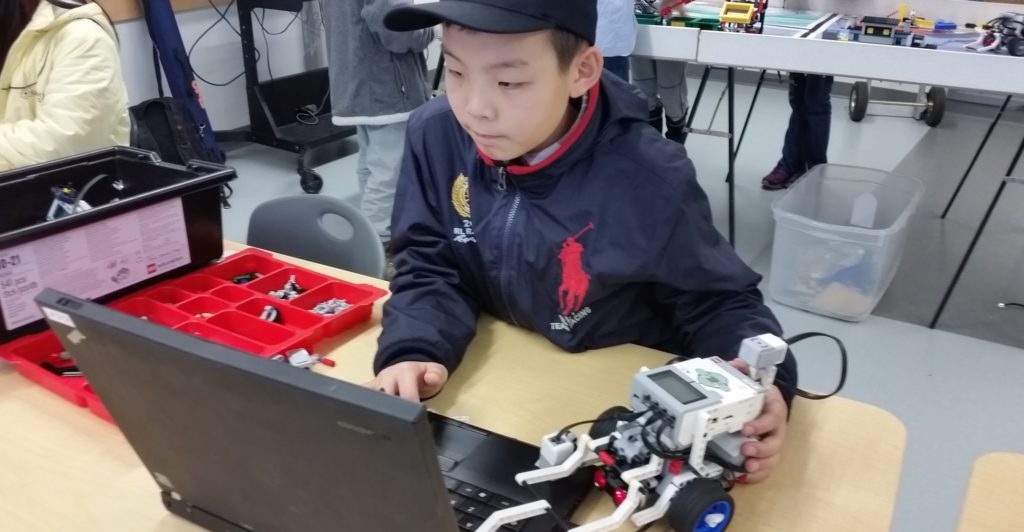
LEGO Robotics

✨ NEW FOR SUMMER 2026 (GraDES 5-8)

Introducing Agentic AI

At Daedalos Enrichment Programs, we’re thrilled to introduce a groundbreaking new experience for our upcoming Summer Camps: Agentic AI Coding with Robots.

If your child loves building with LEGO or wonders how real-world artificial intelligence works, this program is designed for them. We help children understand how AI works behind the scenes, and “demystify” this technology by looking at it side-by-side with traditional block-based coding.

Children signed up for our Agentic AI option will take turns at our AI station after receiving training on robotic design, sensors and motors, and the responsible use of AI, as well as walking through block-based coding with our instructors. They practice prompt engineering, troubleshooting, and critical thinking as they progress throughout the week. No previous experience required!

💻 AI Coders

This is our newest program for kids grades 6 and up. They will have the opportunity to learn how to understand how AI works within the context of robotics and to guide our custom made AI agent in various programming tasks. 

Campers describe what they want their EV3 or SPIKE robot to do in plain English, work with AI and their instructor to generate the code, then test, tweak, and debug until it works.

The debugging is where the real learning happens. Our instructors never just give the answer — they guide kids to find it. They also provide challenging missions the robot must accomplish with its new agentic AI capabilities!

What your child will learn

  • Review real Python syntax, variables, functions, and loops
  • Working in pairs with AI as a coding launchpad — prompt, review, refine
  • Debugging skills: reading errors, testing hypotheses
  • Sensors, navigation, and obstacle-avoidance challenges
  • Competition-style challenges —

“I build my Agentic AI robot and now the sky is the limit!”

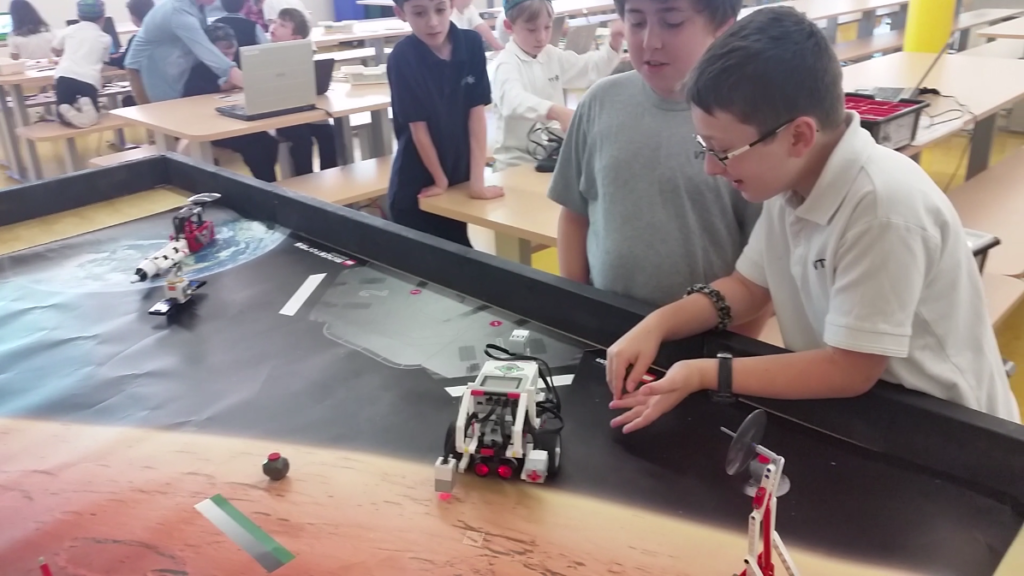
Kids at Vancouver Talmud Torah working with LEGO Mindstorms Robotics

AI Coders: HOW THE LEARNING WORKS

The 4 Steps of the Test & Learn Cycle

Our curriculum uses an intuitive, circular process that empowers kids to think like real engineers. Tap each step to see how it works.

1

🗣️ Kids Prompt AI

The journey begins with your child’s imagination.

Campers type or speak natural-language commands directly into our system. For example, a student might simply say: “Go forward 1 metre and then turn left.” This makes coding instantly accessible, highly engaging, and fun.
2

💻 Agentic AI Compiles Code

The AI interprets their English and writes Python.

The agentic AI compiles the child’s instructions into Python code, compatible with both LEGO SPIKE Prime and LEGO Mindstorms EV3. Campers get a front-row seat to how modern AI bridges the gap between human speech and machine logic.
3

🤖 Robot Follows

The physical LEGO robot springs to life.

Once the code is compiled and sent, students watch their machine execute their intent — driving forward, turning, avoiding an obstacle, or navigating a custom-built challenge course.
4

💡 Iterate, Improve

This is where the deepest learning happens.

In engineering, things rarely go perfectly on the first try. Students troubleshoot, evaluate how their robot performed, and analyse the outcome — then return to Step 1 to refine their prompts, tweak their strategy, and try again.

THE BIGGER PICTURE

Why “Agentic” AI?

Traditional coding classes teach kids to follow a strict recipe. Agentic AI teaches them how to think iteratively and push the boundaries of what the robot can actually do. Students first discuss the responsible and ethical use of AI in the context of robotics coding. They are then walked through our Test-and-Learn Cycle: imagining tasks, prompting AI to create code, running that code on the robot, and iteratively improving the robot’s performance.

By using “physical AI” in the form of robots running AI-generated code, kids learn how agentic AI actually works through direct trial-and-error experience. Through this process, they develop critical thinking, problem-solving skills, and a real understanding of both the benefits and the limits of using AI in robotics coding — all in a fun, competitive, and collaborative environment that supports learners doing their best work.

Spaces for our Summer Camps are limited. Give your child the chance to build, code, and innovate in a collaborative, tech-forward environment.

A DAY AT CAMP

What a Camp Day Looks Like

TimeActivity
9:00 – 10:30amArrival, overview of main lesson, instructions on coding + start building!
10:30-10:45amOutdoor Break – Play park + Games + snack time
10:45am – 12:00pmRobotics Program Daily Activities for all Grade levels, working in pairs assisted by Robotics Instructors
12:00 – 1:00pmLunch Break (nut-free) – Students bring their own lunch, do outside activities such as badminton, basketball – supervision, sports equipment provided.
1:00pm-3:00pmFull Robotics Program for all Grade levels, with more active teamwork events such as Competition Games and Challenge Missions.
3:00pmPick-up time, class dismissed

Every Camp Unique

We plan different activities customized to the mix of returning and new students, so that no returning student ever does the same thing over again, but instead is given a harder challenge as they progress in their robotics and programming skills. Each year, our games and challenges have been inspired by popular sci-fi and fantasy sagas such as Lost in Space, Hobbit, Lord of the Rings, Harry Potter, Star Wars, and more.

DATES & PRICING

Summer 2026 Sessions

  • Week 1: July 13–17, 2026 · 9am–3pm · University Chapel, UBC | 5375 University Blvd, Vancouver, BC V6T 1K3
  • Week 2: July 20–24, 2026 · 9am–3pm · University Chapel, UBC | 5375 University Blvd, Vancouver, BC V6T 1K3
  • Full-day price: $499/week
  • Half-day price: $299/week
  • Both weeks: $849 (save $201)
  • Siblings: save $75 per sibling
  • Included: all LEGO kits*, tablets*, materials, and instruction at a 6:1 student-to-teacher ratio. (*LEGO kits, laptops, and tablets are the property of Daedalos Academy and cannot be taken home.)

Hands-on with 21st Century Skills

Key Learning Outcomes

Robotics is a highly engaging way to learn 21st century skills including:

  • critical thinking
  • computational thinking
  • problem solving 
  • creativity 
  • communication 
  • collaboration and teamwork

Kids are introduced to the basics of programming, engineering and designing by building robots that actually function, move and respond to stimuli. Because they’re paired up in teams, they learn valuable communication and teamwork skills along the way, giving them valuable skills for the future.

Program FAQs

Which program is right for my child?
Go by age first: 6–8 → Beginner Bots, 9–12 → AI Coders. If your 8-year-old already has coding experience, contact us — we can place them in AI Coders.
Can my child attend both weeks?
Yes — Week 2 builds on different missions and challenges, so nothing repeats. Both-weeks campers get a discount (see Dates & Pricing above).
Do you offer early drop-off or late pickup?
Contact us at info@daedalosacademy.com — we can usually accommodate with advance notice.
Do kids need any coding experience?
No. Ages 6–8 start with visual programming; ages 9+ begin Python from scratch with AI support. We’ve had complete beginners write working Python in their first session. What we teach is the iterative test-and-learn cycle to review, improve, and refine code — much like how top software engineers now work alongside AI.
What’s the student-to-instructor ratio?
6 students to 1 trained STEM instructor — every child gets individual attention.
What should my child bring?
A water bottle and a nut-free lunch. We provide everything else: LEGO kits, tablets/laptops, and materials. (Note: children cannot take home any LEGO or electronic devices, which are the property of Daedalos Academy.)
How does AI help with learning?
Kids describe their goal in plain English through a process we call “Task Imagination”; AI and the instructor co-generate Python code; the child then tests, tweaks, and debugs it — learning by doing, not watching. The challenges and missions the robot must accomplish increase in complexity to keep children working at the edge of their ability, a concept educators call the Zone of Proximal Development (Vygotsky, 1978).
How do you ensure secure, responsible use of AI by minors?
Child safety is built into how our AI station works. We use an open-source language model configured with specific guardrails for use with children, so interactions stay focused on age-appropriate robotics and coding. Children never enter personal information — they only describe what they want their robot to do (for example, “move forward and turn left”). All AI use happens in the classroom under the direct supervision of our trained instructors, never independently. Because we run an open-source model with our own safeguards rather than a general-purpose consumer chatbot, we control what it’s used for and keep the experience centred on learning. Our instructors also use these moments to teach kids about the limitations and responsible use of AI — an important skill in itself.
What are your health and safety protocols?
Every Daedalos instructor has a current and updated First Aid Certification. Additionally, they each hold Boundary Training certifications through Safety of Students 360 — ensuring safe, professional, and appropriate interactions with all children in our programs. Please see our other Health & Safety Protocols here.
Where is camp located?
University Chapel, UBC campus, Vancouver BC. Exact address: 5375 University Blvd, Vancouver, BC V6T 1K3. Free parking available.
Is there a sibling discount?
Yes — register two siblings and save $75 on the second sibling. Email info@daedalosacademy.com to confirm you are registering two children of your own.